Remembering Harry Bramma
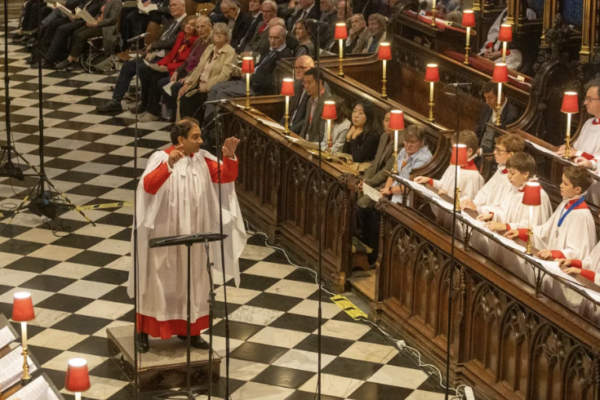
Harry Bramma, who died on 24 August 2026, was one of the most distinctive figures in English church music. His musical career left a lasting mark on the cathedral and church music tradition, leaving behind an enormous legacy. Harry served as Director of Music and Organist at Southwark Cathedral from 1976 to 1989, an appointment he later described as his most enjoyable.
Here, our Trustee, James Gurling OBE, pays tribute to his former Choirmaster and reflects on his time working alongside Harry.

Wit, warmth and candour
Harry Bramma inspired and enriched lives. He helped people realise their potential, and he did so with a benevolent enthusiasm, an ear for the collective good, and a pleasant Yorkshire bluntness that were difficult to resist and arguably statutory requirements for any Choirmaster.
Some time in 1976 Harry embarked on a choral mission – a pilgrimage – around the south London state and diocese schools within easy reach of London Bridge in order to rebuild a voluntary part-time Choir. And it was there that I first met Harry.
I loved singing, but with no regular choir at my home Church I had no real idea what being a chorister entailed, and less still the difference between church and cathedral music.
I was reticent. Joining a Cathedral choir was a massive step for me. Understanding that I had a natural skill at something in which I could excel was one thing. Convincing my very low-church parents that I wouldn’t be corrupted by the ‘smells & bells’ of Cathedral worship was quite another. Harry rose to both challenges with energy and reassurance.
A matter of weeks later I was in the choir and my parents were on the lunch rota cooking full Sunday lunch for 30 in the vaulted basement of the old Chapter House. The Parental volunteers were legendary, and occasionally even famous, and the fellowship amongst them another key achievement that Harry built the choir around.
Just as Harry invested time and charm in his recruitment mission, he built a vibrant and diverse choir, constantly refreshing it with new voices and building us into a cohesive ensemble of talents just as much as of backgrounds. It mattered nothing which school you came from, or where in South London you hailed from. With our dirty-grey cassocks and uncomfortable acrylic ruffs we were forged into one vocal unit each with our own role and place in the total sound.
Creating the ‘Southwark sound’ was as much to do with the choral challenges he expected us to meet as it was with reimagining the choral tradition at this (then) slightly neglected inner-London Cathedral. He would match complementary voices to add depth and richness to the purity of a ‘solo’. And the trebles were quietly supported by an adult female voice – formally an alto, but more often adding strength and volume to the boys voices as we found our level.
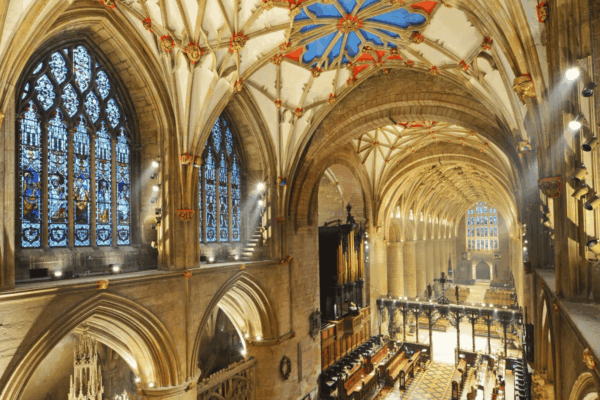
Having built a confident capacity amongst us, he increasingly challenged our capabilities taking us out of our comfort zone introducing us to the delights of more modern composers and showcased the too often unsung prowess of the cathedrals’ magnificent organ and its equally magnificent organists. And with characteristic humility he would occasionally share compositions for us to sing – written by hand but unsigned and produced somehow on the Cathedral’s trusty gestetner printer.
I’m hugely fortunate that Harry heard something in my voice all those years ago, and took a risk on that untutored young boy. I learned a love of so much more musicality than simply the voice and far more about the richness of theology and the cultural traditions that sustain and nurture both.
Amongst so much more, Harry Bramma made lifelong introductions to: Widor and Langlais, Tallis and Byrd, Rose and Rutter, Evensong, Tracker organs, The Wheatsheaf or Market Porter, Theakston’s ‘old peculiar’, Oscar Hamerstein, Lancelot Andrews, and some of the finest friends and colleagues one could hope to meet.
Even in ‘retirement’ Harry’s dedication to the cause of sacred choral music continued unabated. When it was announced that I had joined the Cathedral Music Trust Board, Harry tracked me down, pleased as punch that those formative years hadn’t been entirely wasted.
Just as he did for those choristers in the 70’s, his career sets a high standard for current and future generations. It is humbling, but hugely motivating, to be a small part of the considerable legacy of Harry Bramma.
James Gurling OBE, Trustee, Cathedral Music Trust